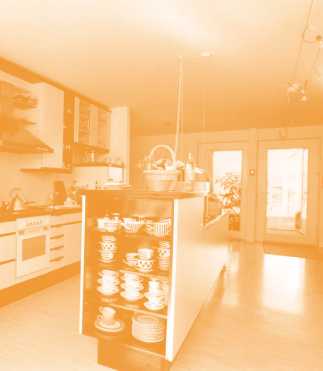
Interior view of Passive House in Darmstadt-Kranichstein, Germany
Photo: Pfäffinger
The term "Passive House" refers to a construction
standard. The standard can be met using a variety of technologies, designs
and materials. It is a refinement of the low-energy house (LEH) standard.
"Passive Houses" are buildings which assure a comfortable
indoor climate in sum-mer and in winter without needing a conventional
heating system.
To permit this, it is essential that the
building’s annual demand for space heating does not exceed 15
kWh/(m²a). The minimal heat requirement can be supplied by
heating the supply air in the ventilation system – a system which is
necessary in any case. Passive Houses need about 80% less heating energy
than new buildings designed to the standards of the 1995 German Thermal
Insulation Ordinance (Wärmeschutzverordnung).
The standard has been
named "Passive House" because the passive heat inputs – delivered
externally by solar irradiation through the windows and provided
internally by the heat emissions of appliances and occupants – essentially
suffice to keep the building at comfortable indoor temperatures throughout
the heating period.
It is a part of the Passive House philosophy that
efficient technologies are also used to minimize the other sources of
energy consumption in the building, notably electricity for household
appliances. The target of the CEPHEUS project is to keep the total final
energy demand for space heating, domes-tic hot water and household
appliances below 42 kWh/(m²a). This is lower by at least a factor of 4
than the specific consumption levels of new buildings designed to the
standards presently applicable across Europe.